
Lessons from a late bloomer
One sailor’s path to learning to sail and buying his first boat didn’t begin until later in life
Most sailors find their way to sailing through some sort of natural exposure. Some grow up beside the water, accustomed to the ding, ding, ding of halyards tapping against masts as they walk past a marina. Eventually, curiosity gets the better of them.
Others have friends or family who sail and, at some point, are lucky enough to receive an invitation to go out on the water.
And then there are those who seem to have sailing in their blood. Their parents had a boat, or an uncle had one, and some of their earliest memories are of being toddlers stuffed into oversized life jackets, playing with a couple of toys on a tiny cabin floor. They grow up with the wind in their hair and the sun on their faces, assuming this is simply what people do.
But not all of us start that way.
I certainly didn’t.
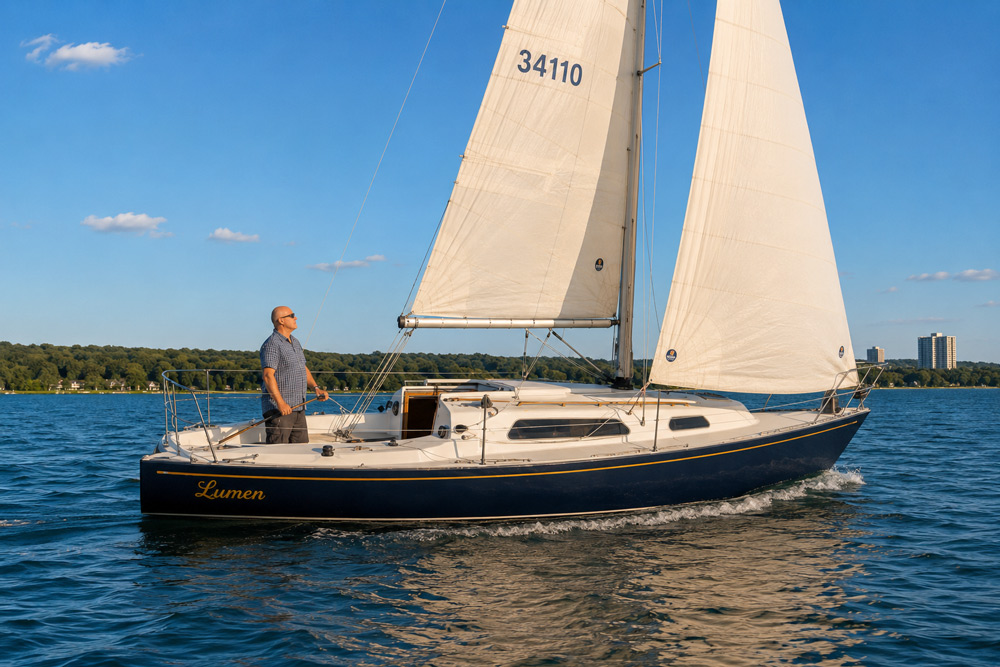
From shore, you see a sailboat gliding peacefully across the water. It’s picturesque. It looks relaxing. But that doesn’t explain why some people become completely consumed by it.
So how does someone who has never been exposed to sailing suddenly become a sailor in his 60s?
For me, it started with YouTube.
A little wind in the sails
Like many people during COVID, I suddenly had more time to wander around the internet. Eventually, I stumbled across people sailing across oceans—some aboard magnificent yachts and others aboard old, affordable boats that looked barely capable of making it across the harbor.
One of the first people who really caught my attention was Sam Holmes, crossing an ocean alone in a somewhat questionable 28-foot sailboat.
There was something captivating about his natural optimism. He could be sailing through a 40-knot gale, waves crashing around him, while calmly talking to the camera with a smile on his face as though this were a perfectly reasonable way to spend an afternoon.
I thought he was crazy, yet I kept watching.
That led me to Tania Aebi’s Maiden Voyage, which led to more books, more videos and more sailors and authors: John Kretschmer, Joshua Slocum, Sailing Zingaro, James Evenson’s Be the Captain, and many others.
Each one blew a little more wind into my sails and eventually, watching wasn’t enough.
What is it about sailing?
Why does sailing become a lifelong passion for some people while much of the rest of the world has absolutely no idea why we do it?
For me, it’s the immersion. Sailing engages your mind, your body and, in a direct way, your spirit.
It’s a little like riding a motorcycle along a winding mountain road on a beautiful spring morning. Your hands, feet, balance, eyes and judgment are all working together. You’re not merely observing what’s around you. You’re completely involved in it. You have to experience it to understand.
Sailing adds another dimension. You leave the shore.You push away from the dock, clear the marina and hoist the sails. The engine goes quiet. And something changes.
The craziness of work, mortgages, traffic, appointments and everyday life begins to disappear. You look ahead and there is nothing but water, horizon, sun and wind. For a while, the rest of the world can wait.
Sailing is also about doing.
It’s learning, adjusting, polishing and occasionally getting things completely wrong. It’s trying to become a little better with the equipment you have and the skills you possess today, knowing that tomorrow the wind will change and you’ll be presented with an entirely different problem.
You never really know what you’re going to get. Except time away from land. And perhaps that’s part of the magic.
How do you get into it?
That’s the difficult part. Assuming you have some money available—whether it’s $500, $5,000, $10,000 or $100,000—there are ways to get into sailing at many different price points.
In fact, I’m not sure whether modern technology has made choosing a sailboat easier or more difficult.
I imagine that 50 years ago you learned about boats from whatever was tied up at your marina, from boats your friends owned, or from something you saw in a sailing magazine. Today, you can sit down at a computer and find more sailboats than you can shake a ship at. And everybody has an opinion about them.
So how do you choose?
There are some excellent YouTube channels that help newcomers understand different boats. But you can learn just as much from ordinary sailors who are cruising or living aboard and simply explaining what they own, what works, what breaks and what they’ve learned.
My own taste in boats evolved with every book I read, video I watched, the sailing course I took, and sailors I have listened to.
For a long time, my dream boat was the Contessa 26: small, beautiful, seaworthy. A boat capable of crossing an ocean despite being shorter than many people’s living rooms. What could be cooler than that?
Once you start shopping, you’re in a world of hurt: keel design, draft, displacement, standing headroom, sailplans, engines, rigging and hull condition. And about a hundred other things you didn’t even know existed six months earlier. Eventually, analysis becomes paralysis.
After spending far too much time trying to determine the “best” boat, I came to a different conclusion. There probably isn’t one.
The best first boat is the one that suits your personality, fits your budget and allows you to do the kind of sailing you want to do right now.
Some sailors spend years improving the same boat. Others sell one and move on to another as their skills and ambitions change. Both can be perfectly happy.
Every boat has a story
One of my favorite things about the Burlington Sailing and Boating Club in Burlington, Ontario, is simply walking down to the docks—following the green road, passing beneath the canopy of trees, while chipmunks appear along the way expecting handouts.
There are large, beautiful cruising boats sitting beside small sailboats that may be 40 or 50 years old. Some are immaculate. Others clearly have another project or two waiting for their owners. Each one has a personality and a story. And somehow, they’re all beautiful.
There’s an extraordinary amount of knowledge and experience sitting on those docks. And I’ve discovered that one of the easiest ways to make a friend at a sailing club is to walk up to someone and say: “Tell me about your boat.” You’ll probably get a tour.
Give them another 10 minutes and you may get the boat’s complete history. If you’re lucky, you might even get invited out for a sail.
Taking the leap
During my own search, I looked seriously at several Contessas and considered a number of other traditional full-keel boats.
Then I stepped aboard the boat that eventually became mine—a 1976 C&C 25.
It wasn’t the boat I’d originally imagined buying, but it had many of the things I wanted in a first boat such as the lines led back to the cockpit, roller furling and solar power. It was a manageable size with enough little conveniences to hopefully keep this new sailor in the cockpit rather than in Lake Ontario.
And it was ready to sail. And after all those months of research, comparisons, specifications and opinions, I did something surprisingly simple.
I said, “OK. I’ll take it.”
Her name is Lumen.
And buying her felt a little like stepping through a doorway into an enormous new world.
There is so much to learn that I occasionally wonder what I’ve gotten myself into. Every time I figure out one thing, I discover three more things I don’t understand.
But that’s part of what makes it interesting.
I’m the new guy. I’m in my 60s. And I’m learning to sail.
“Come, my friends, ’tis not too late to seek a newer world.” --Alfred, Lord Tennyson, Ulysses, 1833
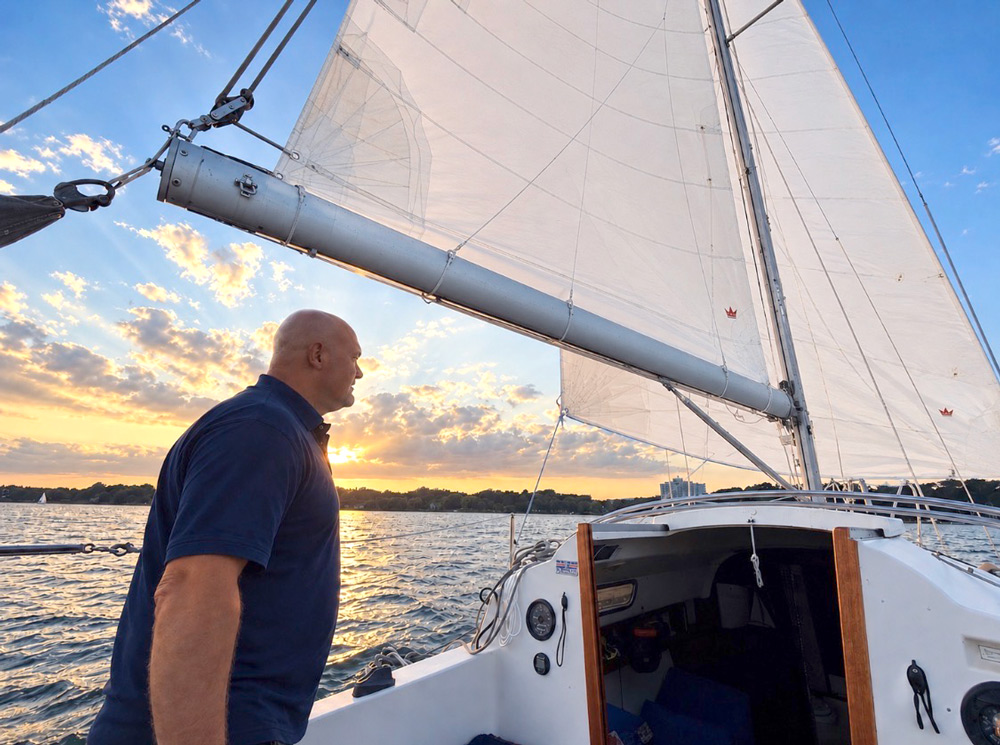
If you’ve ever looked at a sailboat and wondered what it would be like, don’t wait until you’re sitting in a chair at 80 saying, “I always wondered about sailing, but I never tried it.”
Walk down to a sailing club. Ask someone about their boat. Read a book. Watch some videos. Take a lesson. Accept an invitation to crew. Just get on a sailboat once and see what happens. You may discover something you never expected.
Because there is something wonderfully simple about leaving the shore behind. You clear the harbor. You raise the sails. The engine goes quiet. The traffic, noise and craziness of the city slowly disappear behind you.
Ahead, there is Lake Ontario. There is wind. There is horizon. And, for a little while, there is nowhere else you need to be.


Comments