Home Hot Links Advertising Contact Us    
Search        
Sailing
In The Spotlight
PERRY ON DESIGN
By Robert H. Perry

View The Perry Library »


Sailing Magazine
Current Issue

LOA 34’6”; LWL 29’6”; Beam 11’; Draft 6’6” (Standard), 5’6” (Shoal); Displacement 7,750 lbs.; Ballast 3,400 lbs.; Sail area 577 sq. ft.; SA/D 23.57; D/L 134.8; L/B 3.13; Auxiliary Yanmar 20-hp; Fuel 12 gals.; Water 20 gals.
J/Boats, Inc., 557 Thames St., Newport, RI 02840, (401) 846-8410, www.jboats.com.

OBE: $175,000
Our Best Estimate of the sailaway price
November 2006

J/105
One-design excitement

Now it starts to get fun. The smallest IOR “level” class was the Quarter Ton Class. The “ton” part of the name came from an archaic form of measurement the English used for taxing the commercial sailing boats. Quarter-tonners were generally around 24 feet LOA, fat, tippy, heavy, pinched in the ends and not a lot of fun to sail in any breeze. Rod Johnstone decided to build a boat in his garage that would be a fun boat for his family to sail. Rod paid no attention at all to IOR and the boat he built became the J/24. It was stiff, fast and well behaved off the wind. It also was wide enough in the stern to make room for the crew, something the quarter-tonners did not have. Of course at 24 feet LOA the J/24 rated 21.5 under the IOR and this made it compete with the 30-foot LOA Half Ton Class. The simplicity of the J/24 was in marked contrast to the complexity of the current IOR boat and that combined with boat speed was enough to ensure its success. J/Boats has built about 5,400 J/24s and they still build about 309 a year.

IOR died a natural death. I’m not sure why. The boats were getting weird and as the rule went through its changes down to IOR Mark III there was an attempt to make the boat more acceptable to the racing community but factors piled up against IOR and it disappeared to be replaced by the VPP-based IMS rule. IMS was very different from IOR and it measured the entire hull shape, not just certain points in order to get a more complete understanding of the boat’s speed potential. The exact formulae for factoring the elements of the IMS was kept secret from the designers to try to prevent them from finding the loopholes in the rule and exploiting them. But clever designers analyzed their designs with VPP data and soon had IMS figured out. Boats began to get “radicalized” to IMS. The rule administrators began changing the IMS rule yearly to plug the loopholes and this had the effect of making last year’s winner obsolete under the rule for the next year’s racing. This made staying competitive under IMS very expensive. This plus the overall complexity of IMS, which gave different ratings for different races with different conditions made it very unpopular. Sunday’s race results were often not finalized until midweek when all the race weather data had been analyzed. IMS has been replaced by Americap in the United States, IRC, a variation of the old European CHS rule and the venerable and much maligned PHRF. In short, no rating rule is dominant today and this left the racing fleets and designers in a quandary. The door was wide open to another racing format for big boats.

The J/105 introduced one-design racing to the big boat fleets. In a one-design class the boats are restricted to a point where they theoretically can all compete on an equal level with the winner reflecting sailing skill rather than design skill. Dinghies have done it for years. It works. In a strict one-design class, as opposed to a “development class,” you should be competitive over a period of years so long as you maintain your boat and have good sails. In this way resale value is protected and competitive, and long-term fair racing is ensured. J/105 fleets race one-design all over the country and J/Boats has built 720 105s to date.

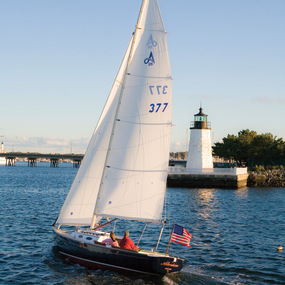
The J/105 was the first production boat to have a retractable bowsprit. This allowed it to fly a large asymmetrical spinnaker. This chute was doused with a snuffer, and without a pole to jibe, the J/105 was a boat a husband and wife could sail comfortably with the chute up. J/Boats swept the spreaders on the 105 and eliminated the need for running backstays. This further simplified operation of the boat. The SA/D is 23.57. Compare this to the 18.5 of the Cal 40. The sailplan shows a handsome boat with a nice sheer and a well-proportioned cabintrunk.

The hull shape has a deep V-ed chest forward, considerable deadrise amidships that fairs to a hard bilge turn at the transom and a flat counter section. Overhangs are minimal and the D/L is 134.8. The keel is a swept fin with a small bulb.

Today, one-design racing is common and one-design classes in the big boat category can be found up to 40-feet LOA. So if you don’t like dealing with the vagaries of an ever-changing measurement rule or the arbitrary nature of PHRF you have an option with the one-design classes.

It would be hard to overestimate the effect J/Boats has had on the American racing scene.
Subscribe
800.895.2596

Links
Back Issues

View the Archives »
 
SAILING Magazine
P.O. Box 249 • Port Washington, WI 53074
Phone: 262-284-3494 • Fax: 262-284-7764


Copyright © 2006 SAILING MAGAZINE
Unauthorized Reproduction Prohibited