About Us Resources Search Contact Us    
   
Sailing
In The Spotlight
FULL AND BY
By Bill Schanen

View The Archives »


MinistryPresence (Design #6) Current Issue


Much like the fins on a 1960s-vintage Cadillac, overhangs contribute little to performance. Simply put, short waterlines mean less sailing speed. Performance, though, is not the priority here. The priority is the look. We’re talking ambience.

Sailing leaps forward to the past on the wings of long overhangs

The long-standing rap against the sailboat industry is that it is not new enough—the old insufficient innovation complaint. I never bought into it myself. But then I have the benefit of a long perspective. I started sailing in an era so primitive that roller-furling and self-tailing winches were not yet even light bulbs in their inventors’ brains. So I’ve seen a lot of new things in sailing, but most of all I’ve seen sailboats get better in every way. Well, that’s all academic now, because sailing has glommed onto something really new that should silence the critics once and for all: New boats that look like old boats.

You’ve heard of going back to the future. Some sailboat builders are leaping forward to the past. They’re marketing boats that are loaded with contemporary high-tech goodies but look like they were designed in the days of wooden hulls and cotton sails.

A lot of developments in the sailing business happen on a whim or a dream, and maybe that is what’s going on here. Or else some market research discovered a great yearning among well-heeled baby boomers for a whiff of the grand old days of yachting. Either way, we’re off on a nostalgia trip.

This is welcome, not because of the nostalgia, but because it gives aesthetics their proper due. Sailing has always seemed bashful about exploiting its beauty. Not now. The looks-like-an-old-boat movement is all about, well, looks. Form is way out in front of function here.

The old-looking boats are brand new, production-built designs. They’re essentially daysailers, big ones—as long as 42 feet. They differ from one another in their underwater form and level of luxury, but they have one thing in common—extravagant overhangs. When you’re on the bow (or the stern, for that matter) of one of these boats, there is a lot of air under you. I’m pretty sure their designers didn’t compare notes, but they all came to the same conclusion: Long overhangs are irresistibly retro.

Promotional copy for the Hinckley DS42 boasts of a “majestic 13 feet of overhangs.” This means that with a waterline length of 29 feet, the length of the overhanging parts of the hull is equal to almost half of the part that is in the water.

I have mixed feelings about this lavish investment in overhangs. Long-ended boats often have a grace that today’s stubbier designs can’t match. Invariably their transoms are prettier than the nearly square backs of contemporary boats. But as in all things, moderation helps. When viewed in a profile drawing, the Hinckley's extreme overhangs, combined with the upturned bow and transom and dipping sheerline, yield a shape that to some eyes might suggest a wooden shoe, albeit an elegant one.

Much like the fins on a 1960s-vintage Cadillac, overhangs contribute little to performance. Simply put, short waterlines mean less sailing speed. Performance, though, is not the priority here. The priority is the look. We’re talking ambience.

The copywriter for the brochure extolling one of the new retros, the Friendship 40, expressed it perfectly: “a look that sends you back to a time when the main purpose of a yacht was pure beauty and grace.”

That said, the retros, in spite of short sailing lengths, haven’t ignored performance. Far from it. The three that attracted the most attention at the U.S. Sailboat Show, in Annapolis, Maryland, the Morris 36, the Friendship 40 and the Hinckley, have high-performance underbodies featuring, respectively, a bulb keel, a modern iteration of a centerboard and a lifting keel. Their rigs have powerful dimensions and the technology of their materials and engineering would be at home on racing boats.

The most practical of them, and the most affordable at just under $300,000 for a well-equipped boat, is the commendably lightweight (7,700 pounds) Morris 36, designed by Sparkman & Stephens. I like the straightforward deck and cockpit layout. The sheets and halyards are set up for singlehanding; a couple could sail this boat easily. The simple interior offers the basics in a tried and true (and retro) layout finished, as the folks at Morris say, “Herreshoff style” with painted surfaces and cherry trim.

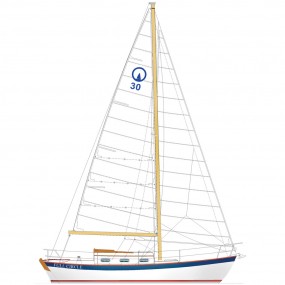
“Practical” is not a word I would use to describe the Friendship 40. “Fantastic,” as in a boat that is an object of sailors’ fantasies, fits better. I have a print of a painting that portrays the afterguard of an early 20th century yacht sailing on a windy day. They’re dressed in blue blazers, white trousers and shirts and white yachting hats with black brims. Their dark ties are askew in the breeze. My usual afterguard uniform is a T-shirt and shorts, but I think I would dress like the yachtsmen in the painting to take my Friendship 40 on a turn around the harbor. A friend of mine described the boat as “dock jewelry.” All jewelry should be so pretty.

Designer Ted Fontaine didn’t let overhang lust get the better of him.The Friendship’s ends are more moderate than others of the genre, but still generous enough for a handsome counter stern and a proud bow. The low coachhouse joins seamlessly with an encircling cockpit coaming, within which are plushly cushioned seats, a permanent table and a traditional faceted binnacle.The accommodations below are—I can’t think of a better word—romantic, evoking the romance of grand sailing yachts and the other kind of romance. The sole berth looks queen sized.

The Friendship will cost you roughly half a million dollars more than the Morris. That includes an electronic furling boom operated with buttons at the helmsman’s feet, but not lifelines. In fact, none of these retros come with lifelines.

That makes sense. A picket fence of stanchions and lifelines would spoil their good looks. They’re not meant to go far offshore anyway, and besides, yachts of the era they’re trying to recall did not have lifelines. I just hope this sits all right with the retros’ target market.

In Annapolis I observed a boomer generation couple talking with a salesperson aboard one of the retros. The man praised the boat’s workmanship and asked about the price. The woman asked about lifelines—why were they missing, aren’t they required by the Coast Guard, did he expect anyone to go out on the water without them? It’s safe to say Americans are more concerned about security today than the were in the grand old days of yachting.

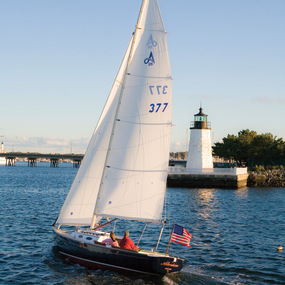
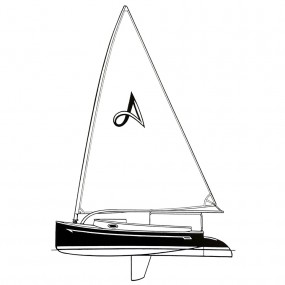
Old may be the newest thing in sailing now, but the current crop of retros can’t claim to be the first to embrace the concept. The Alerion Express 28, designed by the late Carl Schumacher, appeared years ago as a modern take on a revered classic. In this space I once praised “its understated lines, all grace and harmony with short overhangs, a conservative sheerline and low stern.”

Short overhangs? I guess, even though the look of the Alerion is derived from an 87-year-old design by Nathanael G. Herreshoff, that means we can’t call it retro. What I called it in that 1997 column was “the most beautiful currently built production boat” of them all. The Alerion is still being built, and I haven’t changed my mind.

Subscribe

Links

Back Issues

View The Archives »
 
SAILING Magazine
P.O. Box 249 • Port Washington, WI 53074
Phone: 262-284-3494 • Fax: 262-284-7764
E-mail: general@sailingmagazine.net