|
Current Issue
|
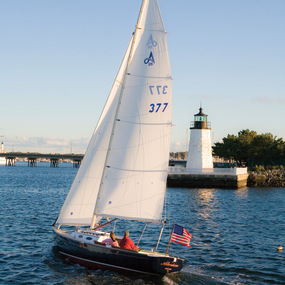
Rosenfeld’s artistry, emulated by Barlow and a select few others, was to capture the instant when everything was perfect. It was as though the sea were their studio, and they had arranged everything just so.
|
|
 |
Portraits of the beauty of sail in living black and white
It’s not often that complaints brighten your day, but I was delighted to hear from several readers who criticized the white border around the June issue’s cover photo. I was rather partial to the border myselfit seemed to work with the picture of a small white boat against a background of dark green foliagebut it was nice to find that some readers cared enough about the magazine to weigh in on this small graphic experiment. What’s more, they made a good point: SAILING has big pages to display beautiful photographs of sailboatswhy make them smaller with a border?
Sailing photos deserve big pages, for there are few objects more worthy of being photographed than a sailboat. Sailboats possess an inherent beauty in the lines of their hulls and the shape of their sails that may be unique in the world of enthusiast activities. Golfing doesn’t need an oversize magazine.
The environment, of course, has to get some credit for making sailing picturesque. It’s the sea and sky along with the invisible wind that bring the subject to life, not to mention surrounding it in glorious colors, usually from the blue-green region of the spectrum. That those vibrant colors are so much a part of what we consider good sailing photography today makes it all the more amazing that some of the best sailing photos ever made are black and white.
I’m referring to the works of the peerless Morris Rosenfeld. His film palette had only black and the scale of grays fading to white, yet his images evoke all of the splendor of a sailboat in its element as if nothing is missing.
A few of his exquisite photos appeared in SAILING in the early years when it was black and white too, but Rosenfeld died soon after the magazine started publishing. Among the gifted photographers who were attracted back then to SAILING by our emphasis on photography, the closest to fitting the Rosenfeld mold was Peter Barlow. What Barlow and Rosenfeld had in common, besides their lush, textured black and white prints, was that they were masters of the sailboat portraita boat alone in the film frame, close enough to make out details of boat, sails and crew, far enough away to take in the full context of waves, clouds, spray and light. Rosenfeld’s artistry, emulated by Barlow and a select few others, was to capture the instant when everything was perfect. It was as though the sea were their studio, and they had arranged everything just so.
You don’t see that so much these days. Today’s great shooters, the pros whose splendid work you see in SAILING, like to get in close. They go for the action. The results are dynamic, thrillingbows splitting waves, crews hiked out, spray flying, all bathed in vibrant color. They do this because they can, with tools Morris Rosenfeld never dreamed ofsuper fast telephoto lenses, cameras with shutter speeds fast enough (some pictures are exposed at 1/8000th of a second) to make a sharp image of the fastest action, motor drives, speedy, maneuverable inflatable boats, even helicopters.
Contrast that with Rosenfeld, who went to sea in doughty cruisers he named Foto with a clumsy 4-by-5 camera with slow, short focal length lenses. That made his job difficult, but it also helps account for his glorious results. With no motor drive to reel off a series of images and the need to laboriously hand develop large individual sheets of film, Rosenfeld had to make every shot count. Much of his genius was the ability to patiently wait for and then recognize the instant when all was right. It’s significant that he started his career as a portrait photographer. In fact, he likened capturing light falling on the planes and curves of a sailboat to photographing a woman’s face.
Rosenfeld wrote in 1947 that “photography to meespecially ship photographyis an art. It is so true an art that it can stand no glamorizing, and I have never striven for ‘arty’ effects.” He was such a purist that he disapproved of the filters that could easily add dramatic effect to seascapes.
I wonder what Rosenfeld would have thought of what has become the camera type of choice of today’s “ship photographers” the digital camera. With this invention, which he could not even have imagined, every image is massaged after the fact, by the photographer’s computer or the publisher’s or both, sometimes to enhance dramatic or arty effect.
That isn’t a criticism of contemporary marine photography. Digital manipulation of color, contrast and brightness is not unlike the enhancements Rosenfeld applied to his images when he developed film and made prints in his darkroom.
Rosenfeld’s sailing photographs are owned by Mystic Seaport Museum, a fit steward for this national treasure. Some are featured in a handsome new book published by Mystic under the title Sleek. The book includes the works of other pioneering sailing photographers as well. These are historically interesting, but Rosenfeld’s are something else. One in particular is a classic of the sailboat portrait genrea picture of the legendary Ticonderoga reaching on a day borrowed from sailors’ heaven.
Rosenfeld arranged his “studio” for this portrait with characteristic care. The sea, corduroyed by a lively chop, is silver. The clouds are drifts of fleece, the bow wave a creamy, rolling mass, the wake a churning streak of white. The mighty 72-foot ketch looks at once heroic and lovely. L. Francis Herreshoff, a designer known as much for the outrageous beauty of his works as for their stellar performance, made Ticonderoga beautiful. Morris Rosenfeld made her more so.
Sleek includes some pictures by Morris’ son Stanley, who died recently and whose photos share the attributes of his father’s. And it includes a feature admirers of classic sailing yachts will lovedescriptions and historical profiles of each boat by John Rousmaniere.
The book, alas, does not have my favorite Morris Rosenfeld photograph, his shot from the starboard quarter of Niña beating into Atlantic seas. You can find it in Rosenfeld’s own book,
Sail-ho, published in 1947. I first saw it there as a young boy. The thrilling image that captured both the power of the sea and the power of the incomparable Starling Burgess staysail schooner, was the inspiration for my dreams of offshore sailing.
If you come across a copy of Sail-ho in a used book store, snap it up. It’s a treasure every sailor should own. Readers who didn’t approve of our cover border should love it: The photos bleed off pages almost as big as SAILING’s. There are no borders.
|
 |