About Us Resources Search Contact Us    
   
Sailing
In The Spotlight
FULL AND BY
By Bill Schanen

View The Archives »


MinistryPresence (Design #6) Current Issue


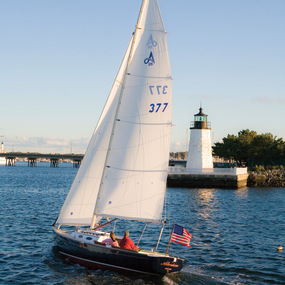
Contemporary high-performance mainsails rise from long booms and stand proud with robust roaches made possible by the high-tech materials now available for sails and battens. Look up from the boom at one of these sails when it is trimmed for beating and you will see something as close to an airplane wing as a flexible object can be. Build it out of aluminum and it would lift a 747. Truly, it is the main sail.

Scandalizing the main was one of sailing’s historic bloopers

A mainsail trimmer I used to sail with was fiercely protective of his sail. When a crewmember would overtrim the genoa and backwind the main, he would chastise the guilty sailor in colorful language, never failing to add: “And don’t forget, there’s a reason they call it the MAIN sail.”

He was right. The mainsail is the most important sail on the boat. It says so in The Oxford Companion to Ships and the Sea: “Mainsail, the principal sail of a sailing vessel.” That’s true now, and it was true through most of the history of sailing, but there was a time when that sail was insignificant and secondary, not to mention ridiculous.

That time, the 1970s and early ‘80s, is remembered as the High-Aspect Era. “High-aspect” was the buzz term that ignited a fad. If you didn’t have a high-aspect mainsail, you were sailing in the past and, if you believed the hype, sailing slowly in the past.

Mainsails of the era achieved the coveted high-aspect status not so much by getting taller on the luff, but by getting shorter on the foot. Foot measurements were shortened to the point where mainsails were shaped like knife blades. Designers seemed bent on out-aspecting one another—mine is higher than yours. I’ll grant that some of them were working under the unwholesome influence of the rating rule that held sway then, the IOR, but that didn’t excuse the cruising boat designers who fell for the concept of the incredible shrinking mainsail.

These sails added no power to the sailplan, but designers and sailmakers told us they weren’t as useless as they looked. Their purpose, they said, was to serve as a sort of vane to balance the genoa and enhance steering ability. That made it official—the genoa was the main sail.

As mainsails shrunk, genoas grew. It was as though all of the sail area removed from mainsails was sewn on to genoas. Genoa clews reached aft to the cockpit, some even beyond the end of the boom.

This was a sad enough state of affairs, but something worse was to come as a result of the scandalizing (the term originally meant to depower a gaff mainsail by dropping the peak, but it fits here) the mainsail. I blame the shrunken mainsail for the worst sail ever invented.

I don’t know who invented the blooper or who named it. The latter should step forward and take credit. The American Heritage Dictionary of the English Language defines “blooper” as “a clumsy mistake,” which describes the sail perfectly. The former should stay in hiding. There are sailors out there still having nightmares about bloopers who might want revenge.

The blooper was supposed to fill the void in downwind sail area left by the diminished mainsails. Shaped more or less like the outside third of a spinnaker, it flew (on the rare times it actually flew) leeward of the spinnaker. It was the only sail in history that had to be trimmed by constantly raising and lowering the halyard. It required a trimmer on the halyard and another on the sheet, but it demanded the attention of the entire crew. Those not trimming were needed to give advice to those who were and to curse the wretched thing when it collapsed and disturbed the air around the spinnaker. If you had to buy a blooper (and a lot of us were convinced we had to), the best way to get it to contribute to the speed of your boat was to leave it at home in the garage.

Garages and landfills are about the only places you’ll find bloopers these days. That’s where most of the incredibly shrunken mainsails have gone too. Real mainsails are back in a glorious iterations of the principal sail that have never been more powerful and effective.

It is fitting that this has been accompanied by the withering of the genoa. On the latest racers, headsails neither overlap the mast nor reach the masthead. They’re secondary sails. The drive comes from the main.

Contemporary high-performance mainsails rise from long booms and stand proud with robust roaches made possible by the high-tech materials now available for sails and battens. Look up from the boom at one of these sails when it is trimmed for beating and you will see something as close to an airplane wing as a flexible object can be. Build it out of aluminum and it would lift a 747. Truly, it is the main sail.

Now that we’ve buried high-aspect mainsails, it’s safe to say one positive thing about them—with those stubby booms, they sure were easy to furl or flake. Today’s long-footed mains are, to put it mildly, challenging in that regard. Racing versions are made of stiff, slippery stuff and they’re attached to the mast only by means of a bolt rope in a tunnel, which means that when they’re let down they’re not attached. A well-drilled racing crew can usually get control of the writhing mass of a lowered, crumpled mainsail and carefully fold and balance layers on the boom. Two people could conceivably accomplish this too, given about an hour, flat water, no wind and a generous amount of good karma. In other conditions, the mainsail is a shorthanded crew’s main problem.

A wise friend once counselled me to never participate in a do-it-yourself wallpapering project with my wife if I valued the marriage. The same advice applies to working with your wife on the flaking of the mainsail. Since the two of us are often the delivery crew, this threat to domestic tranquility has been unavoidable. Let me just say that when you’ve struggled to get within three folds of stacking the sail properly on the boom and the whole affair slides off, it is at least as incendiary an event as tipping the wallpaper paste pot over. Entering a harbor with the mainsail looking like a train wreck in a huge, disorderly pile on the cabintop and deck is one of sailing’s embarrassing moments, but all things considered, better than divorce.

Big mainsails are hard to handle in a lowered state even on cruising boats, but here sailing technology has come to the rescue. A plethora of devices are available to tame the main and save marriages. These range from variations of traditional lazy jacks that automatically flake the sail to sophisticated mast and boom furling systems. My favorite is one that can roll a full-sized mainsail with a sizable roach and proper battens into a compact hollow boom. It takes the sail down, stores it and can even reef it.

When sailors give up racing, some of them buy powerboats.
If that day ever comes for me, I’m not going to buy a trawler or a picnic boat; I’m going to buy one of those nifty furling booms, so I can sail into the sunset on good terms with the MAIN sail.

Subscribe

Links

Back Issues

View The Archives »
 
SAILING Magazine
P.O. Box 249 • Port Washington, WI 53074
Phone: 262-284-3494 • Fax: 262-284-7764
E-mail: general@sailingmagazine.net