About Us Resources Search Contact Us    
   
Sailing
In The Spotlight
FULL AND BY
By Bill Schanen

View The Archives »


MinistryPresence (Design #6) Current Issue


Simple joys and simple boats—for many, that’s sailing

When I started sailing there was no such thing as a Sunfish. I guess I’ve just dated myself as an ancient mariner. The Sunfish recently turned 50.

Before the most popular sailboat in history was born, kids like me, and most sailors of any age, sailed in boats, rather than on them. Then came this boat that was essentially a board with a simple—you might say primitive—sail. The magic of the Sunfish was that at the same time it made sailing simpler, it made it more fun.

No one would seriously suggest that the balloon-tire bicycles popular half a century ago were as good as today’s sophisticated mountain and road bikes. Or that the long, clumsy skis that were the state of the art then have not been rendered museum pieces by the high-tech skis and bindings now available even at the sport’s entry level. Or that the ‘51 DeSoto has not been eclipsed by better cars. Yet there are people who believe that no one has improved on a sailboat introduced in 1951. As if to validate their belief, the Sunfish continues to sell briskly in competition with highly engineered contemporary boats. This tells us something about the nature of sailing.

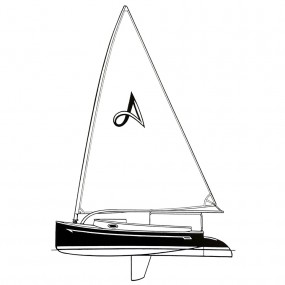
With their designs for the Sailfish and Sunfish, ice-boating buffs Alex Bryan and Cortlandt Heyniger reduced sailing to the purest form imaginable before the advent of the sailboard. The hulls were like surfboards with the addition of a shallow foot well and simple dagger board and rudder. The idea for the rig was hundreds, or thousands, of years old—a lateen sail hung on a stubby mast.

Built of wood, the boats had a growing cult of followers. When a chemical company owner persuaded the designers to try fiberglass, the Sunfish took off as a worldwide phenomenon. More than 300,000 have been sold.

You could say the success of the Sunfish derives from its low cost and ease of handling, but you would be only about half right. True, a boat that sold new for a few hundred dollars years ago and even today has a retail price of about $2,500 (less than some mountain bikes) pretty much eliminates the biggest barrier to getting into sailing. And a boat that weighs only 129 pounds, can be rigged in a few minutes and sailed safely by beginners certainly takes a lot of the hassle out of sailing.

But if that were the sum of its attributes, the Sunfish would be a forgotten mediocrity like the ‘51 DeSoto. The rest of the story is that the boat is a terrific performer. It’s a rare boat that can be loved by novices and experienced sailors alike, but the Sunfish is one of them. In the hands of an able sailor, with that big lateen sail, as long on the foot as it is on the luff, eased, the boat is a planing machine.

What the Sunfish phenomenon tells us about the nature of sailing is that the rewards of sailing are easily accessible. You need water and a little wind, but you don’t need high tech. This doesn’t mean that the significant advance of innovation and technology in sailing has been a waste of time—just that a rather large number of sailors are content with a boat that stopped evolving before most of them were born.

The very first boat inducted into the American Sailboat Hall of Fame, which was founded in 1994, was the Sunfish, chosen because it had introduced more people to sailing than any boat in history.

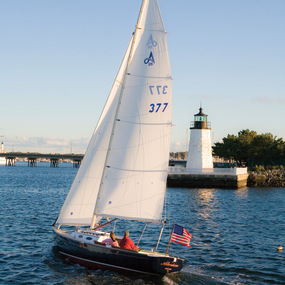
The boats admitted to the Hall of Fame this year share a characteristic with the Sunfish—endurance. One of them, the Ensign, was introduced 40 years ago. Not only has it remained popular, but it’s going back into production after a hiatus of 19 years. This is a basic boat whose popularity rests largely on its ability to deliver the joy of sailing with little fuss.

Certainly the Ensign has nothing else in common with the Sunfish. It’s a husky 22-foot, 6-inch long keelboat, with a deep cockpit big enough for the whole family. Introduced by Pearson Yachts in 1962, the Ensign was designed by Carl Alberg, whose boats were among the faster fiberglass designs of the time. Even today, the boat’s performance is spritely enough to satisfy devoted racers in some 40 one-design fleets across the country.

But its other constituency is made up of people who just want to go sailing—jump in the boat, pull up the sails, take off. The Ensign is their kind of boat. I used to sail occasionally on an Ensign owned by a friend who took a decidedly casual approach to sailing. He didn’t spend much time maintaining the boat. I never heard of him buying anything new for it. But no sailors in our fleet squeezed more fun out of their boats than he did from his somewhat tired Ensign. One day when I pointed to his scalloped jib luff and observed that the halyard needed tightening, he mumbled something about the cam cleat being worn out and propped a beer can under the halyard where it passed over the cuddy cabin. This instantly yielded a jib luff that was Bristol-fashion smooth.

You wouldn’t catch a Pacific Seacraft 37 owner jury-rigging a sail adjustment like that. They tend to be picky about the way they care for these canoe-stern craft that they firmly believe are the most beautiful sailboats in the world. The boat is mentioned here because it went into the Hall of Fame with the Ensign.

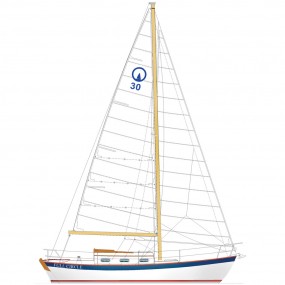
The Pacific Seacraft 37 is a bluewater cruising boat designed to cross oceans, yet it’s like the Ensign in that it is as relevant today as when it was designed in 1976 by the renowned ocean voyager and author Bill Crealock. People are waiting in line to buy it because it still does what it did so well 25 years ago—meld seakindliness with speed in a boat perfectly proportioned for a couple or small crew.

Meanwhile, the march of technology does go on in sailing, to the delight of many sailors, including this one. I love the way the sail roller-furls on the elegant little carbon fiber mast of our Escape beach boat, and I appreciate all of the whiz-bang stuff on our big boat. I believe vacuum-bagging, sail-molding, carbon fiber, Kevlar, Vectran, Spectra, electronic widgets of all kinds—you name the innovation—have improved sailing immeasurably.

But while a certain number of us can’t get enough of this stuff, others don’t want it, don’t need it. For them, sailing is a matter of simple joys and simple boats.

Fifty years from now, one of the cleverly designed roto-molded boats with roller furling masts and self-tending booms that have recently enlivened the entry-level market could be the most popular sailboat in the world.

Or it could be the Sunfish.

Subscribe

Links

Back Issues

View The Archives »
 
SAILING Magazine
P.O. Box 249 • Port Washington, WI 53074
Phone: 262-284-3494 • Fax: 262-284-7764
E-mail: general@sailingmagazine.net