An update of the design J/Boats made famous amps up the fun factor and gets you on the water faster
When the Johnstone boatbuilding family came up with the concept for their new J/111 speedster, ease of getting underway played a key role in deciding on the design.
Since Jeff and Stuart Johnstone comprise the J/Boats marketing team, through self-testing and customer feedback they’ve come to know what current and potential owners want, and one of those things is more time on the water, and less complication at the dock. Delivering on that demand meant conferring with chief designer Alan Johnstone to create a boat that functions as a daysailer, racer and occasional weekender, and which requires little preparation before shoving off.

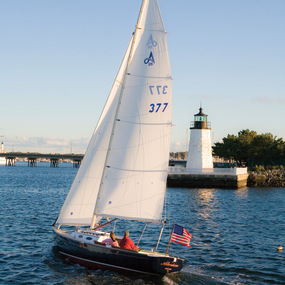
It was a warm summer afternoon in Newport, Rhode Island, shortly after the J/111’s public debut, when SAILING Magazine joined the Johnstones aboard their latest design. As promised, in minutes we were off the dock at Fort Adams and sailing toward the Newport Bridge spanning Narragansett Bay, the J/111 pointing impressively high into the wind and cranking along at 7 knots.
The sleek 36.5-footer with its cut-out transom, nearly plumb bow and retractable sprit, presented a racy profile on the water.
The details
All control lines—halyards, reefing, furler and sprit—are led back to the cockpit. The Harken traveler is mounted on the cockpit sole where a recessed groove accommodates the bottom few inches of the 60-inch-diameter Edson destroyer wheel. Having such a big wheel means the helmsman can comfortably sit to windward to steer the boat and still see both the leading edge of the headsail and the waves. I put two fingers on the wheel’s leather cover, moved it an inch in either direction, and the boat instantly responded.
According to Jeff Johnstone, several factors are responsible for such magic, including the E-glass spade rudder with carbon post and the non-stretching configuration of chain and wire cables connecting it to the helm. There are no ropes involved. The steering relies on Edson’s Articu-lock sheaves with needle bearings and integral wheel brake. The J/111 has a laminated balsa-core hull that is vacuum infused with E-glass/vinylester, and a deck laid up by hand.
Below the water, a vertical L-shaped bulb keel keeps the J/111 upright. The stainless steel fin with a lead bulb is mounted in a hull recess with a stainless flange. The leading edge of the keel features a kelp cutter.
A simple sailplan was also part of the “less time at the dock, more time on the water” philosophy guiding the boat’s design.
“We wanted a boat with easy sail management, something that can be handled by two people or even single-handed,” said Jeff, easily reaching back from his position at the helm to adjust the hydraulic backstay. “We also knew we wanted a performance boat that we’d be excited to sail ourselves.”
Simplicity is a driving force aboard the J/111. As Jeff put it, “We have found that a sailboat that’s easier to sail is sailed more often. It’s as simple as that.”
Stuart heartily agreed, pointing to the non-overlapping headsail. “There’s no big genoa on this boat,” he said.
The J/111 is in some respects a turbo version of the J/105, which was launched nearly 20 years ago to start the sprit-boat revolution. The J/111 amps up the racer in the cruiser/racer formula by having a back-to-basics racing interior for less weight, longer waterline and more sail area. In general numbers, the J/111 is just over 36 feet, and just under 33 feet at the waterline. It has a slim 10-foot, 10-inch beam, giving it that sleek look. It draws 7 feet, 2 inches. The boat’s maximum upwind sail area is 751 square feet. When downwind, it’s 1,798 square feet.
The low-profile Facnor headsail furling drum is innovative because it’s loaded with flat webbing instead of standard furling line.
The sails are controlled by two Harken Radial self-tailing winches, a two-speed Harken traveler system and a Harken adjustable jib lead system. The organizer at the base of the mast ensures lines remain untangled and run in the appropriate direction to their respective blocks or clutches. Control lines for the retractable bowsprit are led aft internally to a cam cleat mounted in the cockpit. Nobody need go below to launch the sprit.
The Hall Spars autoclaved carbon fiber mast is supported by Nitronic discontinuous rod standing rigging. The seamlessly constructed mast accommodates a double set of tapered aluminum spreaders.
Down below
Belowdecks, the appointments are lean—essentials only. Some of the less sexy but necessary aspects include a wastewater holding tank and 15-gallon fuel tank. The main cabin is spacious, with 6-foot headroom. The galley to port features a two-basin sink with top-opening refrigerated icebox and a freshwater foot pump. The sit-down navigation station to starboard is centered on a wooden desk with hinged lid for chart storage. An instrument panel is close at hand.
The boat has two quarterberths aft, each measuring 6 feet, 9 inches, and if the owner chooses, the forward cabin can be fitted out with a V-berth; otherwise it’s designed as a sail locker. The settee in the main cabin has a length of 6 feet, 4 inches, long enough to sleep on. Options include two fold-up sea berths in the main cabin. The head is basic, private and equipped with a vanity. Although this boat could easily become a weekender, it isn’t designed for extensive cruising.
Access to the 21-horsepower Yanmar 3YM20 three-cylinder, four-stroke engine with saildrive is a no-brainer. Located beneath the companionway ladder, it is contained in a molded, noise-insulated engine box. The ladder, with its teak steps, is removed by unfastening two clips near the top. The bottom legs of the ladder, fitted into round holes in the cabin sole, simply lift out. With ladder set aside, four stainless steel slide bolts unlock the engine box. There’s plenty of room on three sides to check fluids and make repairs. The engine turns a 16-inch diameter Flex-O-Fold geared folding propeller.
On deck
The simplified accommodation plan creates room for a huge racing cockpit. Like the spacious cockpit, which the Johnstones contend is as perfect for bringing folks aboard during recreational sails or partying at the dock as it is for racing, the deck is unencumbered by excessive hardware. There are few fittings on which to trip or stub a toe. The cabintop rails are stainless steel. The boat features an anchor locker big enough for the aluminum hook, but the bow pulpit has no hardware to hang it, nor is the stem fitted with a roller. This is, after all, a racing machine at heart.
Some customers have ordered autopilots and even electric winches. Unlike manual winches on some boats, those aboard the J/111 can be easily converted to electric. “The winches don’t need to be rebuilt or replaced,” he said. “They’re designed to be converted to power with minimal modification.”
The J/111 is built by CCF Composites in Bristol, Rhode Island, and by J Composites in Les Sables d’Olonne, France.
According to Jeff, by year’s end, or the first quarter of 2012, more than 60 boats will have been delivered worldwide to customers from 10 countries on four continents.
Under sail
As the boat pinched into the wind and made for the bridge, a 12-Meter crossed our bow and shot ahead. With competitive nature, we leapt into pursuit mode, adjusting the sails until the boat’s low center of gravity and relatively light weight of 9,300 pounds (approximately 2,000 pounds less than its predecessor, the J/109), helped it rapidly accelerate. The J/111 was riotous fun to drive, and much more responsive than the boats I’m used to sailing, so I immediately oversteered. Back on course, the J/111 locked in and performed, but the afternoon was waning and we still hadn’t sailed downwind.
Under the Johnstones’ watchful gaze, we fell off until the J/111 was running with the breeze, the hull speed increasing to double digits in a matter of seconds. Jeff asked, rhetorically, “Time to fly the chute?”
But his words went unheard by Stuart who was already on the bow, preparing to raise the asymmetrical spinnaker.
With the bowsprit fully extended and the A-sail drawing, the boat lurched forward with even more speed until we were planing, exactly what the J/111 was made to do.
|
The chine shines and so does the style and handling of this high-tech cruiser
The sailing industry is on the rebound and it’s not due to a government bailout. Builders are beginning to prosper again by making better and more affordable boats—it’s pretty simple really. Recent new models from leading manufacturers represent an impressive commitment to quality, innovation and value. A case in point is the Jeanneau Sun Odyssey 409. This finely honed Philippe Briand design is user-friendly, sleek on deck, roomy below and quite affordable.
Jeanneau, part of Groupe Beneteau, has hit several home runs in recent years, including its popular deck-saloon models. However, the Sun Odyssey series has long been the heart and soul of the company’s fleet and this new 409 model, which replaces the 39i, will soon be showing up at marinas all across the country. This boat has success stamped all over it, and not surprisingly it was voted the European Boat of the Year for 2011.
The details
The first thing you notice about the 409 hull is the pronounced chine. Chines have long been associated with flat, fast-sailing small boats, and more recently on the big-boat ocean racing around-the-world speedsters. It’s no surprise that chines make sense on modern long-waterline, shallow-forefoot big-boat cruisers too. Flat and fast is a nice way to sail, and the 409 will not appreciate being sailed on its ear. I think most of us are OK with that. Furthermore, any spray that you do kick up will be deflected away from the cockpit by the chine. The 409’s chine, a new twist on an old design concept, runs from amidships aft and gives the profile view a nice, angular distinction. I like it, it’s sexy. On the practical side, it also provides a bit of additional form stability and more usable space below by expanding volume in the upper hull sections.
The 409 represents a synthesis of precision engineering and production, the use of state-of-the-art materials, and just enough old-fashioned craftsmanship to give the boat a welcoming feel. Jeanneau maximizes the huge advantages of scale production without diminishing the distinct identity of every model, and that’s not easy to do. Although most Jeanneaus are built in France, the company has plans to build the 409 in Marion, South Carolina, at the plant it shares with Beneteau.
The hull is solid fiberglass, a simple and well-proven construction method. The balsa-cored deck is resin-injected to ensure precise ratios. This process requires two separate molds but the result is worth it as it keeps the deck light and strong, and significantly reduces the chances for delamination through voids. It also produces two finished sides that are nice from an aesthetic and production standpoint. The hull and deck are mechanically and chemically joined on an inward-facing flange. Bulkheads are cut with incredible accuracy and then tabbed to the hull the old-fashioned way. The keel is cast iron and externally fastened. The deep draft is 6 feet, 10 inches, while the shoal-draft keel, which reduces draft to just over 5 feet, should be popular on this side of the Atlantic. Jeanneau uses a structural fiberglass grid in the interior that includes cutouts for access to important hull areas.
On deck
We had a bright, breezy day to test the new 409 on the shimmering waters of Biscayne Bay off Miami. Steve Sullivan and I had the boat to ourselves, and maneuvering off the dock I was immediately impressed. We made a tight three-point turn and headed out the Dinner Key Channel. Once in deep water, we set the furled main and fractionally rigged, self-tacking headsail and headed south on a close reach. With the east wind steady around 15 knots we sped along at near 7 knots, sailing fast and flat, just like we were supposed to.
The 409 cockpit is large and comfortable and well set up for shorthanded sailing. All halyards and lift controls are led aft, and partially under deck, before terminating in a series of clutches on the cabintrunk. The mainsheet, however, which is often found next to one of the halyards on the coachroof and thus inaccessible from the helm, is instead led aft and can be trimmed from either wheel station. Our test boat was fitted with Harken Rewind electric winches, which allow you to both trim and ease a sheet without ever taking it out of the self-tailer. These ingenious winches are revolutionizing the way we trim sails, soon making winch handles optional.
The twin-wheel arrangement makes sense on many levels. It opens up the cockpit, provides good site lines on either tack, and offers clean access to the stern step. Sailing instruments are housed in a pod mounted on the aft end of the lovely teak table and visible from either wheel. There are clever line lockers below each helm seat and excellent access to the steering system through the port lazarette. I like the dedicated life raft locker between the helm seats, and the fold-down swim platform with a telescoping ladder not only makes boarding after swimming easy, but also assists in climbing aboard from a dinghy.
The low-slung deck layout invites you to leave the cockpit and mosey forward. The side decks are wide and although the handholds are a bit low, they do extend forward to about the mast base. Each chainplate is a single pod positioned well inboard for very tight sheeting angles and it’s also easy to slip around. The 409’s spar has double spreaders and the rig is a 7/8ths fractional. Air draft is just less than 60 feet. A rigid vang is standard. The halyards and headsail sheets are Dyneema. There are several different sailplans. The main is available with either standard jiffy reefing or set up for roller furling. A full-batten performance main is optional. A small, roller-furling genoa is standard while the self-tacking working jib and track is optional. Standard deck hardware includes beefy amidship cleats, a Quick 1000 electric windlass, a Delta 44-pound anchor with serious ground tackle and even a bracket for the outboard motor.
Down below
The interior is bright, with light teak veneers and plenty of natural light. Like most Jeanneaus, there are several different layout plans. The most common arrangement for boats sold in North America is the two-cabin, one-head plan that includes a large storage space/workroom to port aft. A three-cabin, two-head plan is also available for the charter trade.
The L-shaped galley is to starboard and features twin sinks with covers that are also cutting boards, a 12-volt fridge, and a two-burner stove with oven. The galley is separated from the saloon by a partial glass partition. In the two-cabin layout, a large head and separate shower stall is immediately to port when you drop below. Access to the workroom is through the head. In the three-cabin model, this head is smaller, and instead of the workroom there are twin double cabins aft.
The saloon includes a U-shaped settee to starboard that drapes around a clever and versatile table. Completely extended, it’s a dinner table that can seat a crowd, folded in half it becomes a cocktail table, and folded again it becomes part of a lounging area with a built-in bar. It also cleverly folds down to form a spare double berth. Opposite, the settee includes a small table that doubles as a navigation station. There are lockers outboard along the hull and additional storage below the settees.
The owner’s cabin is forward. In the two-cabin model there are hanging lockers to port and starboard and a small desk/vanity to starboard. In the three-cabin model, there is an en-suite head in the forward cabin. The 409 features LED lighting throughout the boat, including leather-wrapped LED reading lights in the sleeping cabins.
A 40-horsepower, three-cylinder Yanmar diesel engine with a fixed three-bladed prop with a saildrive transmission is standard. An optional 50-horsepower, four-cylinder engine is also available, and the optional three-bladed folding Flex-o-Fold prop is worth the money. Access to the engine compartment is from behind the companionway and through the aft cabins. Fuel capacity is 53 gallons. The systems throughout the boat are very well thought out, and for the most part, accessible for inspection and service. Jeanneau even offers optional factory-installed solar panels.
Under sail
As Steve and I were putting the 409 through its paces, our first observation was how easily the boat was handled by two people. We immediately felt at home on the boat, which is a sign of a great design. It’s a small thing, but being able to trim the main from the helm is a big step in making a cruising boat more user-friendly. Hard on the wind we maintained speed inside of 40 degrees apparent. Not surprisingly, the 409 seemed to like reaching best. With winds ranging between 12 to 15 knots, we hit 7.5 knots on a sweet beam reach. Several powerboat wakes gave us the chance to see how the 409 handled a chop, and I was impressed as she sliced through the man-made waves without pounding. She did lose momentum, but then accelerated rapidly.
The Jeanneau 409 pushes the right buttons. It is comfortable, sails well, and is designed for easy maintenance while using the latest technologies. It is well built, and backed up by the largest part of the largest sailboat manufacturer in the world. And it’s affordable. No wonder Jeanneau is selling boats.
LOA 40’6’’, LWL 36’1’’, Beam 13’1’’,
Displacement 16,424 lbs., Deep draft 6’10’’, Shoal draft 5’1’’, Ballast deep draft 4,982 lbs., Ballast shoal draft 5,445 lbs., Sail Area 849 sq. ft.
Jeanneau America
105 Eastern Ave. Ste. 202, Annapolis, Maryland 21403
(410) 280-9400
www.jeanneauamerica.com
Base Boat Price
$194,900
The chine shines and so does the style and handling of this high-tech cruiser
The sailing industry is on the rebound and it’s not due to a government bailout. Builders are beginning to prosper again by making better and more affordable boats—it’s pretty simple really. Recent new models from leading manufacturers represent an impressive commitment to quality, innovation and value. A case in point is the Jeanneau Sun Odyssey 409. This finely honed Philippe Briand design is user-friendly, sleek on deck, roomy below and quite affordable.
Jeanneau, part of Groupe Beneteau, has hit several home runs in recent years, including its popular deck-saloon models. However, the Sun Odyssey series has long been the heart and soul of the company’s fleet and this new 409 model, which replaces the 39i, will soon be showing up at marinas all across the country. This boat has success stamped all over it, and not surprisingly it was voted the European Boat of the Year for 2011.
The details
The first thing you notice about the 409 hull is the pronounced chine. Chines have long been associated with flat, fast-sailing small boats, and more recently on the big-boat ocean racing around-the-world speedsters. It’s no surprise that chines make sense on modern long-waterline, shallow-forefoot big-boat cruisers too. Flat and fast is a nice way to sail, and the 409 will not appreciate being sailed on its ear. I think most of us are OK with that. Furthermore, any spray that you do kick up will be deflected away from the cockpit by the chine. The 409’s chine, a new twist on an old design concept, runs from amidships aft and gives the profile view a nice, angular distinction. I like it, it’s sexy. On the practical side, it also provides a bit of additional form stability and more usable space below by expanding volume in the upper hull sections.
The 409 represents a synthesis of precision engineering and production, the use of state-of-the-art materials, and just enough old-fashioned craftsmanship to give the boat a welcoming feel. Jeanneau maximizes the huge advantages of scale production without diminishing the distinct identity of every model, and that’s not easy to do. Although most Jeanneaus are built in France, the company has plans to build the 409 in Marion, South Carolina, at the plant it shares with Beneteau.
The hull is solid fiberglass, a simple and well-proven construction method. The balsa-cored deck is resin-injected to ensure precise ratios. This process requires two separate molds but the result is worth it as it keeps the deck light and strong, and significantly reduces the chances for delamination through voids. It also produces two finished sides that are nice from an aesthetic and production standpoint. The hull and deck are mechanically and chemically joined on an inward-facing flange. Bulkheads are cut with incredible accuracy and then tabbed to the hull the old-fashioned way. The keel is cast iron and externally fastened. The deep draft is 6 feet, 10 inches, while the shoal-draft keel, which reduces draft to just over 5 feet, should be popular on this side of the Atlantic. Jeanneau uses a structural fiberglass grid in the interior that includes cutouts for access to important hull areas.
On deck
We had a bright, breezy day to test the new 409 on the shimmering waters of Biscayne Bay off Miami. Steve Sullivan and I had the boat to ourselves, and maneuvering off the dock I was immediately impressed. We made a tight three-point turn and headed out the Dinner Key Channel. Once in deep water, we set the furled main and fractionally rigged, self-tacking headsail and headed south on a close reach. With the east wind steady around 15 knots we sped along at near 7 knots, sailing fast and flat, just like we were supposed to.
The 409 cockpit is large and comfortable and well set up for shorthanded sailing. All halyards and lift controls are led aft, and partially under deck, before terminating in a series of clutches on the cabintrunk. The mainsheet, however, which is often found next to one of the halyards on the coachroof and thus inaccessible from the helm, is instead led aft and can be trimmed from either wheel station. Our test boat was fitted with Harken Rewind electric winches, which allow you to both trim and ease a sheet without ever taking it out of the self-tailer. These ingenious winches are revolutionizing the way we trim sails, soon making winch handles optional.
The twin-wheel arrangement makes sense on many levels. It opens up the cockpit, provides good site lines on either tack, and offers clean access to the stern step. Sailing instruments are housed in a pod mounted on the aft end of the lovely teak table and visible from either wheel. There are clever line lockers below each helm seat and excellent access to the steering system through the port lazarette. I like the dedicated life raft locker between the helm seats, and the fold-down swim platform with a telescoping ladder not only makes boarding after swimming easy, but also assists in climbing aboard from a dinghy.
The low-slung deck layout invites you to leave the cockpit and mosey forward. The side decks are wide and although the handholds are a bit low, they do extend forward to about the mast base. Each chainplate is a single pod positioned well inboard for very tight sheeting angles and it’s also easy to slip around. The 409’s spar has double spreaders and the rig is a 7/8ths fractional. Air draft is just less than 60 feet. A rigid vang is standard. The halyards and headsail sheets are Dyneema. There are several different sailplans. The main is available with either standard jiffy reefing or set up for roller furling. A full-batten performance main is optional. A small, roller-furling genoa is standard while the self-tacking working jib and track is optional. Standard deck hardware includes beefy amidship cleats, a Quick 1000 electric windlass, a Delta 44-pound anchor with serious ground tackle and even a bracket for the outboard motor.
Down below
The interior is bright, with light teak veneers and plenty of natural light. Like most Jeanneaus, there are several different layout plans. The most common arrangement for boats sold in North America is the two-cabin, one-head plan that includes a large storage space/workroom to port aft. A three-cabin, two-head plan is also available for the charter trade.
The L-shaped galley is to starboard and features twin sinks with covers that are also cutting boards, a 12-volt fridge, and a two-burner stove with oven. The galley is separated from the saloon by a partial glass partition. In the two-cabin layout, a large head and separate shower stall is immediately to port when you drop below. Access to the workroom is through the head. In the three-cabin model, this head is smaller, and instead of the workroom there are twin double cabins aft.
The saloon includes a U-shaped settee to starboard that drapes around a clever and versatile table. Completely extended, it’s a dinner table that can seat a crowd, folded in half it becomes a cocktail table, and folded again it becomes part of a lounging area with a built-in bar. It also cleverly folds down to form a spare double berth. Opposite, the settee includes a small table that doubles as a navigation station. There are lockers outboard along the hull and additional storage below the settees.
The owner’s cabin is forward. In the two-cabin model there are hanging lockers to port and starboard and a small desk/vanity to starboard. In the three-cabin model, there is an en-suite head in the forward cabin. The 409 features LED lighting throughout the boat, including leather-wrapped LED reading lights in the sleeping cabins.
A 40-horsepower, three-cylinder Yanmar diesel engine with a fixed three-bladed prop with a saildrive transmission is standard. An optional 50-horsepower, four-cylinder engine is also available, and the optional three-bladed folding Flex-o-Fold prop is worth the money. Access to the engine compartment is from behind the companionway and through the aft cabins. Fuel capacity is 53 gallons. The systems throughout the boat are very well thought out, and for the most part, accessible for inspection and service. Jeanneau even offers optional factory-installed solar panels.
Under sail
As Steve and I were putting the 409 through its paces, our first observation was how easily the boat was handled by two people. We immediately felt at home on the boat, which is a sign of a great design. It’s a small thing, but being able to trim the main from the helm is a big step in making a cruising boat more user-friendly. Hard on the wind we maintained speed inside of 40 degrees apparent. Not surprisingly, the 409 seemed to like reaching best. With winds ranging between 12 to 15 knots, we hit 7.5 knots on a sweet beam reach. Several powerboat wakes gave us the chance to see how the 409 handled a chop, and I was impressed as she sliced through the man-made waves without pounding. She did lose momentum, but then accelerated rapidly.
The Jeanneau 409 pushes the right buttons. It is comfortable, sails well, and is designed for easy maintenance while using the latest technologies. It is well built, and backed up by the largest part of the largest sailboat manufacturer in the world. And it’s affordable. No wonder Jeanneau is selling boats.'
American Ingenuity with Style
This was clearly one of the boats I liked best at the recent Strictly Sail Miami Show. Although manufacturers are offering a host of mid-30-foot multipurpose boats as the sailboat market continues to come back to life, the Catalina 355 stands out from the pack. It’s a handsome, well-proportioned boat of moderate beam and freeboard. The fairly low-slung cabintrunk completes the pleasing profile. The 355 looks right—it looks like a sailboat. Remember the axiom, form follows function? It definitely applies to this latest model from one of America’s most respected builders. The 355 was introduced at last year’s United States Sailboat Show in Annapolis, Maryland, and has been well received by sailors around the country. It takes its cues from Catalina’s successful 2009 model, the 445. It is basically just a smaller version, which resonates in today’s cautious economy.
The 355 is efficient under sail and user-friendly for comfortable cruising. The cockpit is a prime example of such comfort. The helm seat has been raised and the sailing instrument pods placed outboard, resulting in terrific sightlines from behind the wheel and a nice steering perch when heeled. The primary winches are located well aft, allowing the helmsman a full throw of the winch without releasing the wheel. The molded pedestal houses the engine instruments in a spot where you can actually see them. The cockpit is deep and secure while the backrests are angled for comfort and the benches are long enough to sleep on; Catalina trademarks. The stainless steel cockpit table base doubles as a stout foot support. Our test boat was fitted with an expansive bimini top and spray dodger.
The details
The 355 is well engineered and manufactured using Catalina’s unique five-piece system. The first piece consists of a one-piece solid fiberglass hull. Next is a molded structural grid that is designed to support serious loads, including the keel, mast and rig. By molding the grid separate from the larger hull liner, Catalina is able to make it strong without comprising its construction to support furniture facings. The one-piece molded hull liner is part three, while the molded deck liner is part four. The deck liner is actually bonded to part five, the deck, while both pieces are still in the mold, require manufacturing precision.
The 355’s deck is balsa cored. Catalina has always used lead keels, and the 355 is no exception. Lead concentrates the weight where it should be, down low, and although it is expensive, it’s the best material for keel construction. The keel is externally fastened to the hull with beefy 316 stainless bolts. The rudder is a stainless steel framework with fiberglass over a foam core.
On deck
There is a huge, well-organized locker to port designed, in part, to stash folding bikes. The opening to the stern step has a clever retractable lifeline gate and the stern rail seats are hard to resist. In fact, I spent a good portion of the boat test perched on the starboard seat while scribbling notes. The clever stern rail incorporates a lower outboard motor bracket that is well placed for easier motor handling. Twin backstays open up access to the wide stern step. Naturally all sail controls are led aft, and I especially like the 5-foot Garhaurer traveler with 6-to-1 purchase and single-side handling from the port side.
Catalina has returned to its traditional diamond pattern nonskid. Well-supported 28-inch stanchions and stout handrails on the coachroof lend security when navigating from the cockpit to the foredeck along the relatively narrow side decks. The genoa tracks are well inboard and long enough to move the leads forward for efficient trimming even when the furling genoa is reefed. The shrouds are set well inboard, allowing for tight upwind sheeting angles. The anchoring arrangement is rather impressive. The 355 features double stainless rollers, a fairly deep locker and an electric windlass. The aft bulkhead of the chain locker is actually part of Catalina’s patented “impact absorbing collision zone,” a watertight bulkhead that will help keep the boat afloat in the event of a collision. A removable bowsprit, which stores in the chain locker, allows for a furling Doyle UPS reaching sail to be flown forward of the pulpit.
Below the waterline the 355 has two keel configurations: the standard fin keel with a 6-foot, 8-inch draft, and a wing keel that draws a more moderate 4 feet, 6 inches. The balanced rudder is positioned well aft and provides excellent steering control, even when running before following seas. Designer Gerry Douglas’ hull shape is subtle. While the waterline is quite long, there is still a bit of rake to the bow and a nice lift to the stern. Like I said, the 355 looks like a sailboat.
Down below
The interior plan works brilliantly because Douglas does not try to make the 355 fit every bill. It is a genuine two-cabin boat with one terrific head, a working galley and a very comfortable saloon. What more could you ask for in a boat less than 36 feet long? I was impressed with both the quality of the teak joinerwork and the overall attention to detail.
Three wide, relatively shallow steps escort you below. The L-shaped galley is to starboard. The two-burner stove and oven is outboard with a microwave above. Double sinks face forward and are mounted close to the centerline for clear drainage on either tack. The fridge includes both top and side-loading hatches. There’s adequate food storage in lockers above and under the stove. Access into the aft cabin is through the galley and it is a bit tight. The cabin, however, features a genuine double bunk and a cedar-lined hanging locker. Catalina has gone to innerspring mattresses and that’s a very nice upgrade.
The saloon feels large, in part because of the 6-foot, 5-inch headroom, light teak veneers and plenty of natural light. The layout is clever. The port side settee can also be configured as two seats with a small table between. To starboard, the U-shaped settee includes a quad fold table that extends from cocktail sized to one that can seat six. The head is aft to port and is rather stylish. Douglas calls it “spa-style,” and it includes a raised glass vessel sink, which looks like it might be vulnerable when clutched in a seaway, and a large shower area. Just forward of the head is a small, aft-facing nav station designed for a laptop and minimal chart stowage. The electrical panel and a separate accessory panel are above.
The forward cabin, or owner’s cabin, is luxurious, especially in a boat this size. The double island bunk lifts on the aft end to reveal a large storage bin. The mattress articulates at the forward end, and with the help of an electric lifting device can be inclined to a comfy angle for reading or watching television. There are cedar-lined lockers, a good-sized hatch above and room enough to stand and dress comfortably.
Access to the three-cylinder, 29-horsepower Yanmar diesel is from behind the companionway. The steps pull completely away, making the engine easy to service. Access to the stuffing box is more challenging, although the 355 employs a dripless-style stuffing box, limiting the need to check it regularly. The fuel capacity of 30 gallons will likely translate into a season of motoring. Other systems include hot-and-cold pressure water with just over 100 gallons of freshwater in two tanks and an oversized 12-volt battery arrangement.
Under sail
Out on Biscayne Bay the wind was freshening at last. A light southeast breeze was showing some life and sailing on a close reach with the standard 135% genoa the 355 glided across flat seas at near 6 knots. The 355 is just about masthead rigged; the Seldon spar is a 19/20 fractional section, an arrangement that incorporates the best of both worlds. The mast is deck stepped. Bringing the boat hard on the wind we maintained speed at 40 degrees apparent.
The 355 should like to be sailed flat, on her lines, thus reducing any benefit of trying to squeeze too high. The helm was light, and quite well balanced. We brought the boat through the wind several times, tacking easily without the hindrance of a staysail stay.
I really like the concept of the UPS sail that is furled on its own luff forward of the headstay and out of the way when maneuvering up wind. In heavy weather it can be dropped all together. Off the wind, we reached under the genoa and topped 6 knots in the puffs. Turning the helm over to Steve Sullivan, I climbed into the port stern seat. The view was ideal.
The 355 is part of Catalina’s Cruiser Series, which also includes the 309, 320 and 375. Catalina Yachts recognizes that in order to succeed their boats not only have to perform well, be comfortable and user-friendly, they also have to be exceptional values. With a price at about $170,000, which includes sails and basic electronics, the 355 fits that bill to a T.
|
|