Pacific Seacraft 34
Handsome high-quality cruiser made for crossing oceans in style
The Pacific Seacraft 34 forces you to confront your cruising dreams head on, and that may or may not be a good thing. This capable canoe-stern cutter can carry you as far as your imagination can go. This is a genuine oceangoing sailboat wrapped up in a small package. It is expensive, tooa 15-year-old model can sell for close to or more than $100,000. However, the advantage of a quality small cruiser is the price can be managed, especially for a short-term cruising sabbatical. Do the math. The payments for a year or two at 6 percent are doable.
The PS 34 is ideal for a cruising couple or a good choice for the singlehander. The boat will stand up to the moods of Neptune and is easy to handle. A 34-foot boat is also relatively inexpensive to operate. The PS 34 holds its value well, and when the dream changes, or is completed or aborted, sail back to the harbor, spread some elbow grease and sell the boat for about what you paid for it. The Pacific Seacraft 34 eliminates excuses. Do you really want to go cruising, or do you just want to keep talking about it?
Bill Crealock designed the PS 34 and it is in many ways a scaled down version of his popular PS 37 according to his design comments. Hull No. 1 hit the water in 1978 and today, nearly 400 hulls later, the 34 is still in production. Pacific Seacraft Corporation of Fullerton, California, is a refreshing, enduring and unfortunately rare success story in the capricious sailboat industry. Cited by Fortune Magazine for building one of America’s best product lines, the company has maintained a commitment to quality construction for 25 years. As a used boat buyer it is nice to know that the factory is still operating and even better that the model you’re considering is still in production.
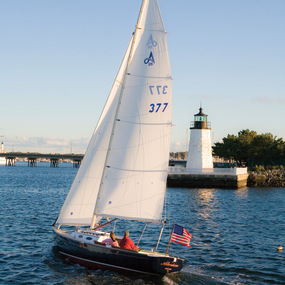
First impressions The PS 34 has a traditional profile and deck layout that’s blended with a fin and skeg underbody mixing old and new design traits. The concept, inspired to a large degree by Bob Perry’s Valiant 40, caught on with many West Coast and Taiwan builders in the 1970s and 1980s and offers an insight into the mixed-up mindset of many sailors. There is something irresistible about a traditional sailboat with a sweeping sheerline and a canoe sternit just seems right for bluewater sailing. There is also something appealing about better performance and the ease of handling offered by a more modern underbody. The marriage of these unlikely design parameters has produced some of America’s best-loved boats, including the Pacific Seacraft 34 and its sisterships.
The PS 34 has a proud sheerline and a raked bow, with an overhang ratio of 23 percent. Yet the optional cutter rig, with a generous 649-square-foot sail area, and the 13,200-pound displacement, makes for a moderate offshore cruiser. The external lead ballast of 4,800 pounds translates into a ballast-to-displacement ratio of 36 percent. The PS 34 sails surprisingly well and owners report that that hull is more easily driven than one might suspect. The single spreader aluminum spar has an air draft of 44 feet, 3 inches and an optional shoal-draft Scheel keel reduces the standard draft from reasonable 4 feet, 11 inches to gunkholer’s fantasy at 4 feet, 1 inch.
Construction The PS 34 has a solid fiberglass hull. The hull is stiffened with a full-length molded liner. Unlike other builders, Pacific Seacraft does an excellent job of providing openings in the liner for hull access and securely bonding the liner to the hull, creating almost a hull within a hull. The liner allows form fitting for components like tanks, furniture facings, structural floors and the engine beds. The deck is balsa cored except in areas of high load where plywood is used. The hull and deck are through bolted on a double flange that allows for the 5-inch deck bulwark and is covered by a beefy teak caprail. It is a muscular and almost always watertight union. And, just in case you ding up the caprail, it is installed in short 5-foot sections, secured with a “butterfly joint,” allowing for easy and affordable sectional replacement.
Bulkheads are well tabbed in place and also through-bolted from the deck via a teak beam, making them extremely rigid. The rudder is robustly constructed with a steel backbone (or web) that is welded to the stainless steel shaft. A hefty bronze gudgeon is through-bolted to the steel reinforced skeg and offers lower bearing support for the rudder.
The keel is a molded stubby with external lead ballast through-bolted, arguably the best solution to the question of which is better: internal or external ballast. Pacific Seacraft pays attention to details. Small items like molded angled platforms ease the load on cockpit locker hinges and aligned screw and bolt heads are a nice touch and typical of the original factory workmanship still evident on older boats.
What to look for The quality of the PS 34 jumps out at you the first time you amble alongside, from the chromed bronze ports to the stout bronze and stainless deck hardware. However, like every used boat there are certain items to check for. The most common problem, according to Roy Pinney, a longtime Pacific Seacraft dealer who has also logged thousands of miles aboard the 34, is the aluminum fuel tank. Located under the saloon bilge, the tank bottom sags after time and is exposed to both seawater and the stainless steel keel bolts, a sure recipe for electrolysis.
“If you smell diesel when you step below, the tank may well be leaking,” Pinney said. Typical of Pacific Seacraft, the tank is easily removed through cockpit sole hatches without major surgery. The same fiberglass tank that is standard on new boats can be retrofitted in a couple of hours. The 1990 model that Pinney and I crawled though in Ft. Lauderdale had the original tank and there was no sign of electrolysis or leaks.
If you are looking at a boat older than 15 years, be alert for signs of hull blistering. Pacific Seacraft, like virtually every manufacturer, had its share of blister boats in the early and mid-1980s, and some bottom treatments were better than others.
Also, one more item to be aware of is that some 34s came from the factory with tiller steering, not many, but you can usually spot them in the sale listings because they invariably have lower asking prices. If you prefer or can live with a tiller, you can save a few scheckles on a used 34.
On deck The PS 34 cockpit is fairly deep and roomy, especially considering the space lost as the canoe stern curves inward. The seats are 6 feet, 5 inches long and are good for sleeping although the backs are a bit abrupt. The bridgedeck is well designed as it will keep water out of the cabin and is wide enough not to limit foot room in the cockpit well.
The primary sheet winches are just forward of the helm. Most 34s lead the sail controls aft, which is part of the popular but optional Singlehander’s or Voyager’s package. Most 34s on the used market will have self-tailing Lewmar primaries, but new boats now come standard with Harken winches.
The PS 34 sports deck hardware usually found on larger boats. The stern cleats are 10 inches long and the bronze stern chocks are equally robust. The bow and stern pulpits are beefy and the stanchions are mounted both vertically and horizontally for strength. Double lifelines are 30 inches high. The 5-inch bulwark, aggressive molded nonskid and teak grab rails on the cabintrunk make navigating the side decks a safe and secure operation. The chain locker is internal and can only be accessed from the forepeak. The forward hawsepipes run through the bulkhead, a feature that would please the pilots in the Panama Canal Zone.
The mainsheet traveler is located just forward of the hatch, and is a midboom sheeting arrangement that keeps the cockpit uncluttered. It also allows for mounting a spray dodger that can stretch well back into the cockpit, two good reasons for putting up with the inefficiency and extra loads created by midboom sheeting. The spar is deck-stepped and the massive chainplates are mounted outboard. Some boats will have a fixed staysail headstay and others will opt for a mobile arrangement, which is preferred as it allows the option of sailing as a sloop with an overlapping genoa in light air.
Down below The layout belowdecks is conventional and it works very well. The forward V-berth is of good size, the berths are 6 feet, 6 inches long and 5 feet, 11 inches across at the widest spot. Bookshelves line both sides. The bunk is a molded section with storage below. The head is next aft to port with a large hanging locker opposite. The saloon includes straight settees that make good sea berths and the port settee converts into a double. Most boats will have a fixed centerline table but some will have foldaway bulkhead table that can really open up the boat.
Although the beam is only 10 feet the interior feels spacious due to 6-feet, 3-inch headroom and numerous opening portlights and overhead hatches. The headliner is a soft, foam-backed vinyl that can be unzipped to access deck fittings. The joinerwork is clean and functional and the generous use of hand-rubbed teak offsets the production boat look that liners create.
The shallow U-shaped galley is aft to port and usually includes a Force 10 two-burner stove outboard, double stainless sinks forward, and a well-insulated six-cubic-foot icebox aft. This boat was conceived as a cruiser and there is clever storage everywhere, including a hinged dish locker above the icebox, although there isn’t room for much counter space. A large forward-facing nav station is opposite with the electrical panel outboard. Behind is a good-sized quarterberth, which often ends up as another storage area.
Engine Most 34s on the used market are fitted with a three-cylinder 34 to 37-horsepower Yanmar diesel. The horsepower rating depends on the year of the engine. This model, the 3JH2E is a terrific machine and is very efficient. The standard fuel tank holds just 37 gallons, which will likely translate into 60-plus hours of motoring.
One of the best features of the PS 34 is engine access, which is about as good as it gets for a small cruising boat. While the front of the engine is reached by removing the companionway steps, a cockpit access hatch allows access to the back of the engine and the stuffing box. It also floods the compartment with light. Pacific Seacraft did not shoehorn the engine in place, there is plenty of room to work, and if re-powering is necessary, the engine can be easily removed through the cockpit hatch.
Under way Comfort is defined different ways, and to Crealock, comfort is directly related to motion under sail, or lack there of. The hull shape of the PS 34 will treat you kindly, even in choppy, lumpy conditions, and that makes the boat comfortable in the most important environment of all, at sea.
“The 34 will surprise you with its speed,” Pinney said, “It has logged impressive runs crossing the Pacific.” The cutter rig adds more than 100 square feet of working sail, although that balances out on the sloop rig if a genoa is used. If you do set up the boat as a cutter you will need to rig running backstays, which are part of the package.
Michael Rowen sails his PS 34 in breezy San Francisco Bay. Surprisingly he has elected to forego furling headsails and is content with the options that his hanked-on 130-percent genoa, high-cut working jib and staysail offer.
“I never feel like I can’t quickly set up the right combination and I don’t mind going forward to change headsails, it keeps me young.”
He usually shortens down to the yankee when the winds near 20 knots. He ties in the first reef in the main when wind pipes up to 22 knots apparent.
Crealock notes that the canoe stern enables the boat to maintain surfing speeds when running before large ocean rollers while maintaining control and easy steering. My experience has shown that canoe sterns are not as fast off the wind but they do in fact keep the stern from wandering. On the wind, the 34 is not particularly close-winded but tracks well and weather helm does not seem to be a common complaint. Pinney noted that the 34 has an impressive bluewater track record, including more than one circumnavigation.
Conclusion
The PS 34 is an excellent example of a quality, small cruising boat, designed and built to sail anywhere. Its best feature just may be that it eliminates any excuses to delay that much talked about cruising sabbatical.